

Werx Academy
How Can Contractors Forecast Cash Flow Accurately?
A good forecast shows when cash gets tight before it happens. Plan payroll, materials, and draws with confidence.
Cash flow forecasting projects when money comes in and when it goes out. It maps your draws against payroll, materials, and overhead. With that map, you spot a tight month early and plan around it.
Why does forecasting matter in construction?
Construction cash never flows in a straight line. Pay apps lag, retainage gets held, and costs swing. A forecast turns that chaos into a plan you can act on.
- Spot tight cash before it hits
- Plan ahead for payroll, materials, and equipment
- Line up draw schedules with project milestones
Weak forecasting is a top entry on this list of common cash flow mistakes.
What methods do contractors use to forecast cash flow?
Pick the method that fits your size and job mix. The real key is updating it on a set schedule.
- Historical forecasting: use past jobs to predict patterns
- Real-time forecasting: update with actuals from active jobs
- Scenario forecasting: test "what if" delays or cost swings
What makes forecasting hard?

Even with good intent, many contractors fall behind. Bad data is usually the reason.
- Manual spreadsheets that rarely get updated
- Payment delays you cannot fully predict
- Leaving retainage out of the forecast
- Ignoring seasonal swings in demand
When should you update your forecast?
Match the cadence to the work. Busy seasons need a closer look.
Review monthly as a baseline. Move to weekly during active jobs or a tight stretch. Rerun the forecast any time a big draw, change order, or delay lands.
- Slow season: monthly review
- Active jobs: weekly review
- After a change order or delay: rerun right away
How does contractor software simplify forecasting?
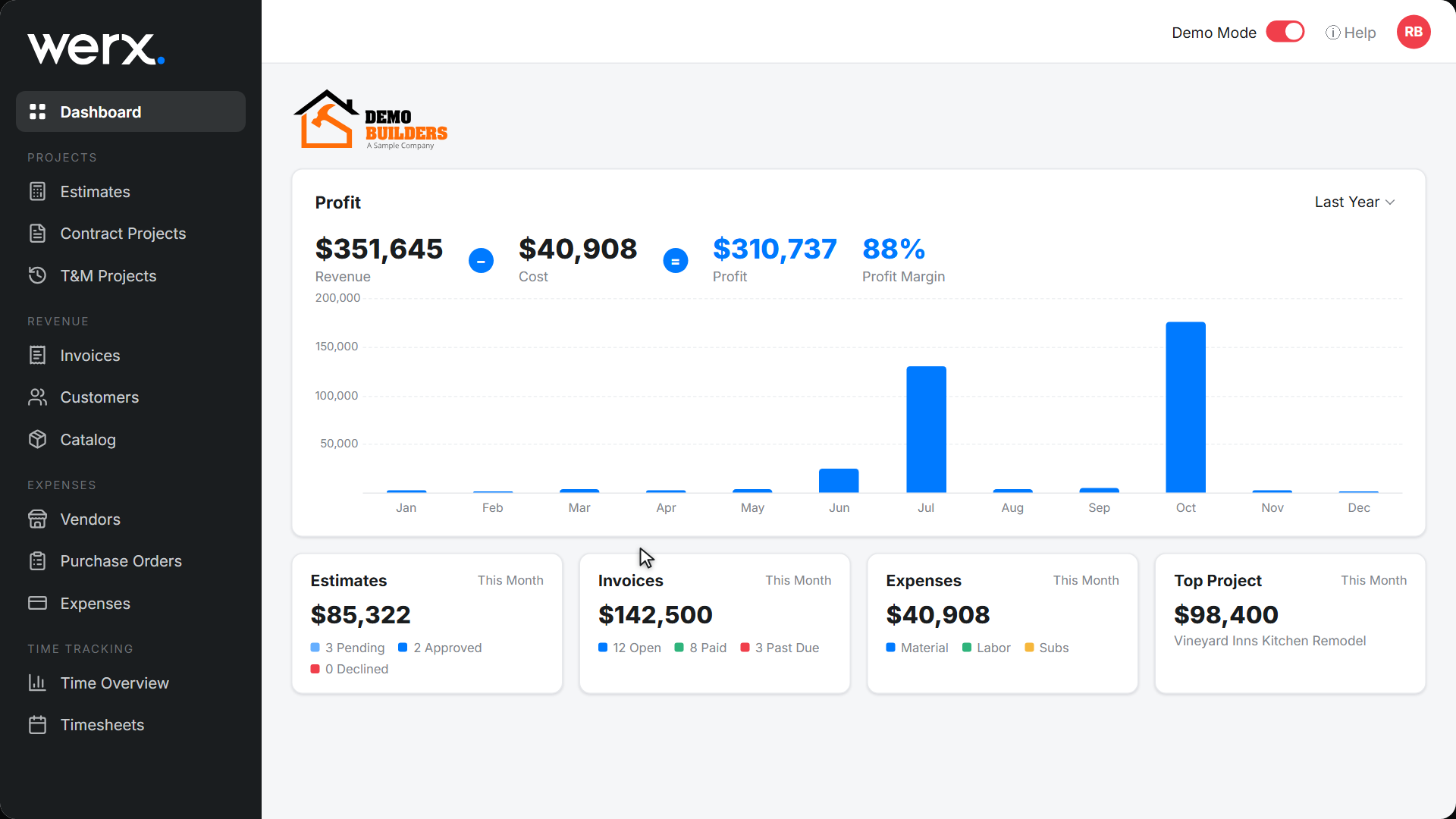
Contractor software like Werx feeds the forecast with live data. It links billing, job costing, and QuickBooks so projections stay current.
- Live data feeds for up-to-date projections
- Automatic tracking of retainage and payment timelines
- Job-level cost visibility to catch overruns
- Cash flow dashboards by week, month, or job
Key takeaways
- A forecast shows tight cash before it becomes a crisis
- Use historical, real-time, and scenario views together
- Update monthly, then weekly during active jobs
- Werx feeds the forecast with live billing and job-cost data
Frequently Asked Questions
What is cash flow forecasting in construction?
It projects when cash comes in from clients and when it goes out for payroll, equipment, and materials.
How often should contractors update cash flow forecasts?
Monthly is a fine baseline. During active jobs, a weekly review gives the most accurate picture.
Can small contractors benefit from forecasting?
Yes. With tight margins, even a minor delay can hurt. A forecast gives small contractors early warning.
Ready to grow your business?
Start your 14-day free trial today. No credit card required.
No credit card required · Free migration assistance · Cancel anytime