
Solar billing works best when you split each install into milestones and bill as you hit them. That keeps cash coming in across long permitting and inspection timelines. Solar jobs also carry heavy material costs, so tight tracking protects your margin.
What makes solar billing different?
Solar sits in one of the fastest-growing corners of construction, but it bills unlike most trades. A few things set it apart.
Multi-phase projects
A typical residential solar install runs through several stages: site assessment, permitting, equipment order, installation, electrical hookup, and inspection. Each stage has its own costs and can map to its own billing milestone.
High material-to-labor ratio
Solar jobs lean heavy on materials like panels, inverters, and racking, often more than on labor. That makes accurate material tracking and markup control key to holding your margin.
Incentives and rebates
Solar work often involves federal tax credits, state incentives, and utility rebates. You may not manage these directly, but they shape the proposal and the client's expectations, so factor them in early.
Long timelines
Between permitting, utility interconnection, and inspection scheduling, a solar job can run weeks or months. Long timelines make steady, milestone-based invoicing a must for cash flow.
Which billing method should solar contractors use?
| Labor — journeyman, 32 hrs @ $95 | $3,040 | |
| Labor — apprentice, 24 hrs @ $55 | $1,320 | |
| Materials — pipe, fittings, valves | $1,180 | |
| Equipment — trencher rental, 2 days | $640 | |
| Markup on materials & equipment (15%) | $273 |
Progress billing
For larger residential and commercial installs, progress billing tied to milestones is the most common approach. Typical milestones:
- Contract signing (deposit)
- Equipment delivery
- Installation complete
- Inspection passed and system commissioned
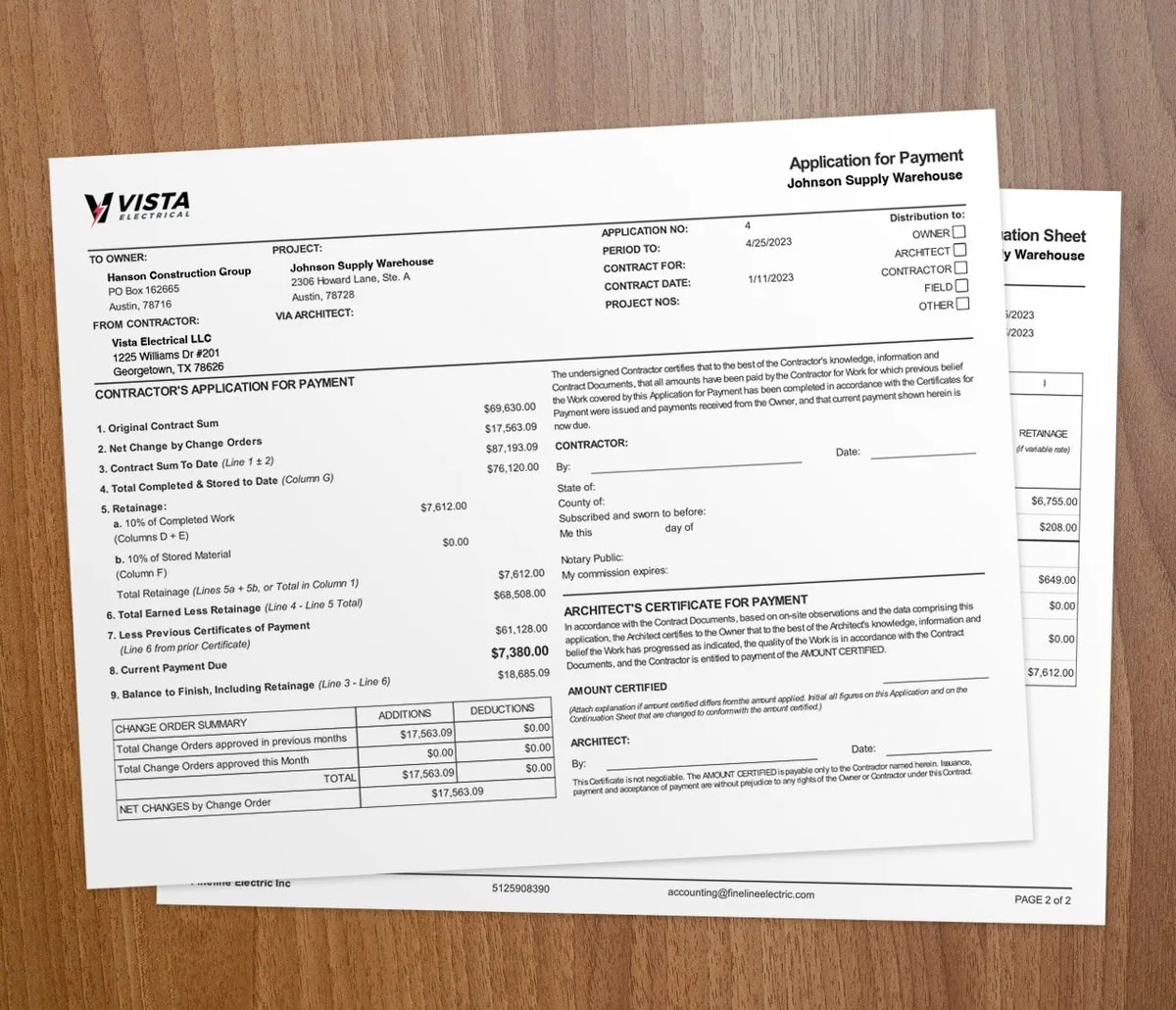
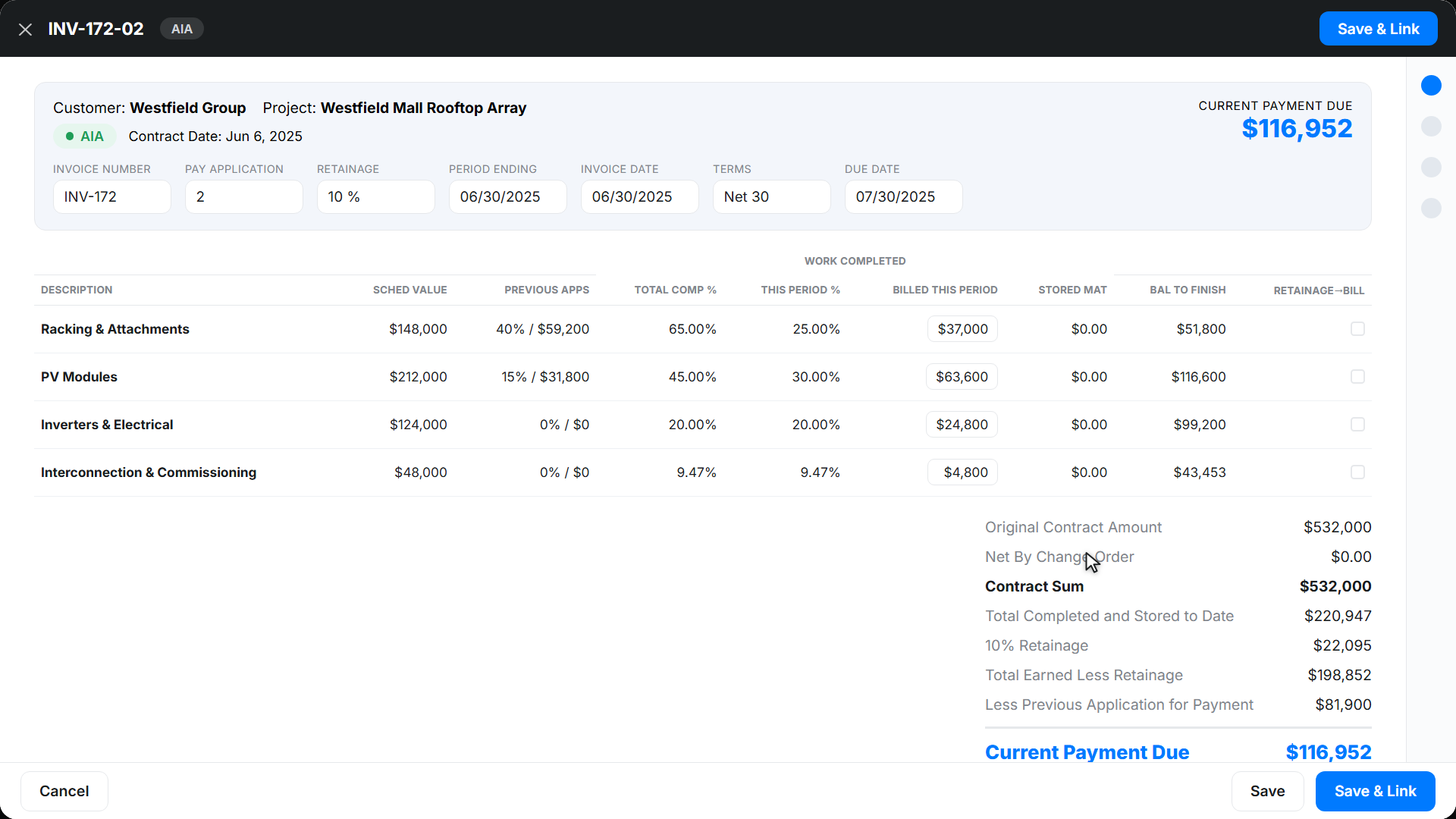
On commercial solar, owners and general contractors often expect AIA-style billing with G702 and G703 forms. Commercial jobs also tend to hold retainage of 5% to 10% until the system is commissioned, so track every held dollar. Our free retainage calculator shows the math for your own numbers.
Time and materials
For service calls, system changes, or jobs with fuzzy scope, time and materials billing lets you charge for the actual work done. To see when it fits best, read the benefits of time and materials billing.
Fixed-price contracts
Many residential systems sell at a fixed price per watt or a flat system cost. With fixed price, your estimate has to be sharp, because any overrun comes straight out of margin. Our guide to fixed-price vs T&M contracts breaks down the trade-offs.
How do you keep solar billing on track?
Start with a detailed estimate
Open every job with a full estimate that itemizes equipment, labor, permitting, and overhead. A clear estimate sets expectations and anchors your billing for the rest of the job.
Track time in the field
Labor is a real cost on every solar job. Mobile time tracking captures each hour and ties it to the right project, which keeps job costing and billing accurate.
Invoice at every milestone
Do not wait until the system is on to bill. Invoice at each set milestone to keep cash steady. Set your system to generate the bill as soon as a milestone is met.
Offer easy payment options
Make paying simple with online payment processing. When clients can pay by card or ACH transfer from the invoice, collection times drop. Net-30 terms collect faster when a payment link is right there.
Sync with accounting
Push billing data into your QuickBooks integration to skip double entry. That matters most when you run several installs at once and need clean numbers across all of them.
When should you use each billing method?
Use progress billing for big multi-phase installs where the scope is set and the job runs for weeks. It keeps cash moving and matches what commercial owners expect.
Use time and materials for service work, repairs, or any job where the scope is unknown going in. Use fixed price for standard residential systems you can estimate down to the watt. Many solar shops run all three, picking the method that fits each job.
How does software help as you grow?
As your solar business grows, billing gets harder. Running five installs at once is a different job than running one. Contractor software like Werx helps you scale without losing financial control.
Use progress billing tools to watch actual cost against your estimate across every job, from first quote to final payment. For the labor side, see how real-time job costing keeps each install profitable.
Key takeaways
- Solar jobs run in phases, so milestone-based progress billing keeps cash flowing.
- Material costs are high on solar work, so track equipment and markup closely.
- Use progress billing for big installs, T&M for service work, and fixed price for standard systems.
- Commercial solar often uses AIA G702/G703 forms and holds 5% to 10% retainage.
- Contractor software like Werx ties estimates, time, billing, and QuickBooks together.